Once upon a time...
There was once a woman who wished very much to have a little child, but she could not obtain her wish. At last she went to a fairy, and said, "I should so very much like to have a little child; can you tell me where I can find one?"
"Oh, that can be easily managed," said the fairy. "Here is a barleycorn of a different kind to those which grow in the farmer's fields, and which the chickens eat; put it into a flower-pot, and see what will happen."
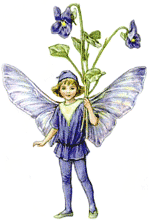
"Thank you," said the woman, and she gave the fairy twelve shillings, which was the price of the barleycorn. Then she went home and planted it, and immediately there grew up a large handsome flower, something like a tulip in appearance, but with its leaves tightly closed as if it were still a bud. "It is a beautiful flower," said the woman, and she kissed the red and golden-colored leaves, and while she did so the flower opened, and she could see that it was a real tulip. Within the flower, upon the green velvet stamens, sat a very delicate and graceful little maiden. She was scarcely half as long as a thumb, and they gave her the name of "Thumbelina," or Tiny, because she was so small. A walnut-shell, elegantly polished, served her for a cradle; her bed was formed of blue violet-leaves, with a rose-leaf for a counterpane. Here she slept at night, but during the day she amused herself on a table, where the woman had placed a plateful of water. Round this plate were wreaths of flowers with their stems in the water, and upon it floated a large tulip-leaf, which served Tiny for a boat. Here the little maiden sat and rowed herself from side to side, with two oars made of white horse-hair. It really was a very pretty sight. Tiny could, also, sing so softly and sweetly that nothing like her singing had ever before been heard. One night, while she lay in her pretty bed, a large, ugly, wet toad crept through a broken pane of glass in the window, and leaped right upon the table where Tiny lay sleeping under her rose-leaf quilt.
"What a pretty little wife this would make for my son," said the toad, and she took up the walnut-shell in which little Tiny lay asleep, and jumped through the window with it into the garden.
In the swampy margin of a broad stream in the garden lived the toad, with her son. He was uglier even than his mother, and when he saw the pretty little maiden in her elegant bed, he could only cry, "Croak, croak, croak."
"Don't speak so loud, or she will wake," said the toad, "and then she might run away, for she is as light as swan's down. We will place her on one of the water-lily leaves out in the stream; it will be like an island to her, she is so light and small, and then she cannot escape; and, while she is away, we will make haste and prepare the state-room under the marsh, in which you are to live when you are married."
Far out in the stream grew a number of water-lilies, with broad green leaves, which seemed to float on the top of the water. The largest of these leaves appeared farther off than the rest, and the old toad swam out to it with the walnut-shell, in which little Tiny lay still asleep. The tiny little creature woke very early in the morning, and began to cry bitterly when she found where she was, for she could see nothing but water on every side of the large green leaf, and no way of reaching the land. Meanwhile the old toad was very busy under the marsh, decking her room with rushes and wild yellow flowers, to make it look pretty for her new daughter-in-law. Then she swam out with her ugly son to the leaf on which she had placed poor little Tiny. She wanted to fetch the pretty bed, that she might put it in the bridal chamber to be ready for her. The old toad bowed low to her in the water, and said, "Here is my son, he will be your husband, and you will live happily in the marsh by the stream."
"Croak, croak, croak," was all her son could say for himself; so the toad took up the elegant little bed, and swam away with it, leaving Tiny all alone on the green leaf, where she sat and wept. She could not bear to think of living with the old toad, and having her ugly son for a husband. The little fishes, who swam about in the water beneath, had seen the toad, and heard what she said, so they lifted their heads above the water to look at the little maiden. As soon as they caught sight of her, they saw she was very pretty, and it made them very sorry to think that she must go and live with the ugly toads. "No, it must never be!" so they assembled together in the water, round the green stalk which held the leaf on which the little maiden stood, and gnawed it away at the root with their teeth. Then the leaf floated down the stream, carrying Tiny far away out of reach of land.
Tiny sailed past many towns, and the little birds in the bushes saw her, and sang, "What a lovely little creature;" so the leaf swam away with her farther and farther, till it brought her to other lands. A graceful little white butterfly constantly fluttered round her, and at last alighted on the leaf. Tiny pleased him, and she was glad of it, for now the toad could not possibly reach her, and the country through which she sailed was beautiful, and the sun shone upon the water, till it glittered like liquid gold. She took off her girdle and tied one end of it round the butterfly, and the other end of the ribbon she fastened to the leaf, which now glided on much faster than ever, taking little Tiny with it as she stood. Presently a large cockchafer flew by; the moment he caught sight of her, he seized her round her delicate waist with his claws, and flew with her into a tree. The green leaf floated away on the brook, and the butterfly flew with it, for he was fastened to it, and could not get away.
Oh, how frightened little Tiny felt when the cockchafer flew with her to the tree! But especially was she sorry for the beautiful white butterfly which she had fastened to the leaf, for if he could not free himself he would die of hunger. But the cockchafer did not trouble himself at all about the matter. He seated himself by her side on a large green leaf, gave her some honey from the flowers to eat, and told her she was very pretty, though not in the least like a cockchafer. After a time, all the cockchafers turned up their feelers, and said, "She has only two legs! how ugly that looks." "She has no feelers," said another. "Her waist is quite slim. Pooh! she is like a human being."
"Oh! she is ugly," said all the lady cockchafers, although Tiny was very pretty. Then the cockchafer who had run away with her, believed all the others when they said she was ugly, and would have nothing more to say to her, and told her she might go where she liked. Then he flew down with her from the tree, and placed her on a daisy, and she wept at the thought that she was so ugly that even the cockchafers would have nothing to say to her. And all the while she was really the loveliest creature that one could imagine, and as tender and delicate as a beautiful rose-leaf. During the whole summer poor little Tiny lived quite alone in the wide forest. She wove herself a bed with blades of grass, and hung it up under a broad leaf, to protect herself from the rain. She sucked the honey from the flowers for food, and drank the dew from their leaves every morning. So passed away the summer and the autumn, and then came the winter,—the long, cold winter. All the birds who had sung to her so sweetly were flown away, and the trees and the flowers had withered. The large clover leaf under the shelter of which she had lived, was now rolled together and shrivelled up, nothing remained but a yellow withered stalk. She felt dreadfully cold, for her clothes were torn, and she was herself so frail and delicate, that poor little Tiny was nearly frozen to death. It began to snow too; and the snow-flakes, as they fell upon her, were like a whole shovelful falling upon one of us, for we are tall, but she was only an inch high. Then she wrapped herself up in a dry leaf, but it cracked in the middle and could not keep her warm, and she shivered with cold. Near the wood in which she had been living lay a corn-field, but the corn had been cut a long time; nothing remained but the bare dry stubble standing up out of the frozen ground. It was to her like struggling through a large wood. Oh! how she shivered with the cold. She came at last to the door of a field-mouse, who had a little den under the corn-stubble. There dwelt the field-mouse in warmth and comfort, with a whole roomful of corn, a kitchen, and a beautiful dining room. Poor little Tiny stood before the door just like a little beggar-girl, and begged for a small piece of barley-corn, for she had been without a morsel to eat for two days.
"You poor little creature," said the field-mouse, who was really a good old field-mouse, "come into my warm room and dine with me." She was very pleased with Tiny, so she said, "You are quite welcome to stay with me all the winter, if you like; but you must keep my rooms clean and neat, and tell me stories, for I shall like to hear them very much." And Tiny did all the field-mouse asked her, and found herself very comfortable.
"We shall have a visitor soon," said the field-mouse one day; "my neighbor pays me a visit once a week. He is better off than I am; he has large rooms, and wears a beautiful black velvet coat. If you could only have him for a husband, you would be well provided for indeed. But he is blind, so you must tell him some of your prettiest stories."
But Tiny did not feel at all interested about this neighbor, for he was a mole. However, he came and paid his visit dressed in his black velvet coat.
"He is very rich and learned, and his house is twenty times larger than mine," said the field-mouse.
He was rich and learned, no doubt, but he always spoke slightingly of the sun and the pretty flowers, because he had never seen them. Tiny was obliged to sing to him, "Lady-bird, lady-bird, fly away home," and many other pretty songs. And the mole fell in love with her because she had such a sweet voice; but he said nothing yet, for he was very cautious. A short time before, the mole had dug a long passage under the earth, which led from the dwelling of the field-mouse to his own, and here she had permission to walk with Tiny whenever she liked. But he warned them not to be alarmed at the sight of a dead bird which lay in the passage. It was a perfect bird, with a beak and feathers, and could not have been dead long, and was lying just where the mole had made his passage. The mole took a piece of phosphorescent wood in his mouth, and it glittered like fire in the dark; then he went before them to light them through the long, dark passage. When they came to the spot where lay the dead bird, the mole pushed his broad nose through the ceiling, the earth gave way, so that there was a large hole, and the daylight shone into the passage. In the middle of the floor lay a dead swallow, his beautiful wings pulled close to his sides, his feet and his head drawn up under his feathers; the poor bird had evidently died of the cold. It made little Tiny very sad to see it, she did so love the little birds; all the summer they had sung and twittered for her so beautifully. But the mole pushed it aside with his crooked legs, and said, "He will sing no more now. How miserable it must be to be born a little bird! I am thankful that none of my children will ever be birds, for they can do nothing but cry, 'Tweet, tweet,' and always die of hunger in the winter."
Click Here for Part 2 of Thumbelina Thumbelina Fairy Tale
A Fairy Story
by
Hans Christian Andersen |